Emergency Vet of 11 Years: "Stop Putting That Harness Back on Your Dog." The Invisible Chest Damage Happening on Every Walk — and the Front‑Clip Harness She Designed to End It
Emergency Vet of 11 Years: "Stop Putting That Harness Back on Your Dog." The Invisible Chest Damage Happening on Every Walk — and the Front-Clip Harness She Designed to End It
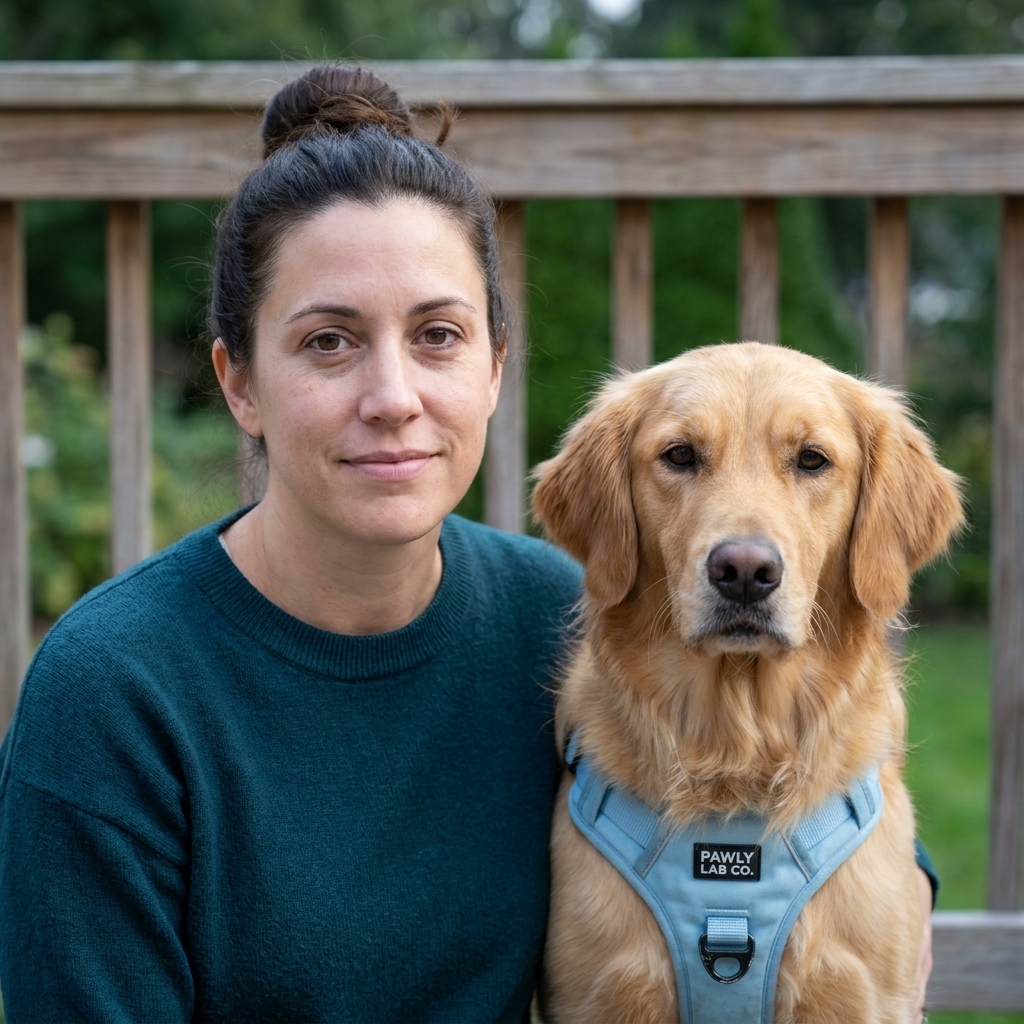
Dr. Rachel Monroe, DVM
Emergency Veterinarian (11 Years) & Creator of the PawlyLabs No-Pull Harness
Aug 26, 2026 | 🕑 8 min read
Your dog is being slowly damaged on every single walk — and you can't see it happening.
Here's what most people don't realize: There are three lies almost every dog parent believes — and they are quietly harming their dogs. Lie number one: if your dog seems fine on walks, he is fine. Dead wrong. The damage is invisible and compounds with every step. Lie number two: harnesses are safe because they're not collars. I tested 94 dogs on the most common harness type sold in America. 79 were already showing signs of strain their families had no idea about. The style doesn't matter. The clip position does. Lie number three: dogs will show you when something is wrong. No. Their survival instinct hides the pain until the damage is already done. Then one 4:23 AM case changed everything...
My name is Dr. Rachel Monroe, and for 11 years I've worked the overnight shift as an emergency veterinarian. I thought I'd seen everything. I was wrong.
His name was Cooper. 4:23 AM, a Tuesday morning. Wheeled into my ER. Six years old. Golden retriever. Perfect health his entire life. Now in cardiac distress. His mom grabbed my arm, sobbing. 'He goes on walks every single day, doctor. We've always been so careful.' I gave her the textbook answer. Genetics. Age. But I knew I was lying. Because that same month, I'd already seen two other dogs with the same story. Young. Healthy. Loved. Then cardiac crisis out of nowhere. And all three families said the exact same thing: 'We walk every day. We thought that was good for him.'
That's not bad luck. That's a pattern somebody needs to figure out. So I became that somebody.
I started collecting data on 94 dogs — all from responsible families, all walked daily, all considered healthy. What I found:
📋
94
Dogs I documented — all walked daily, all considered healthy
⚠
79
Were already showing signs of strain their families had no idea about
❤️
3
Cardiac crises in a single month — same story, same gear, same 'we walk every day'
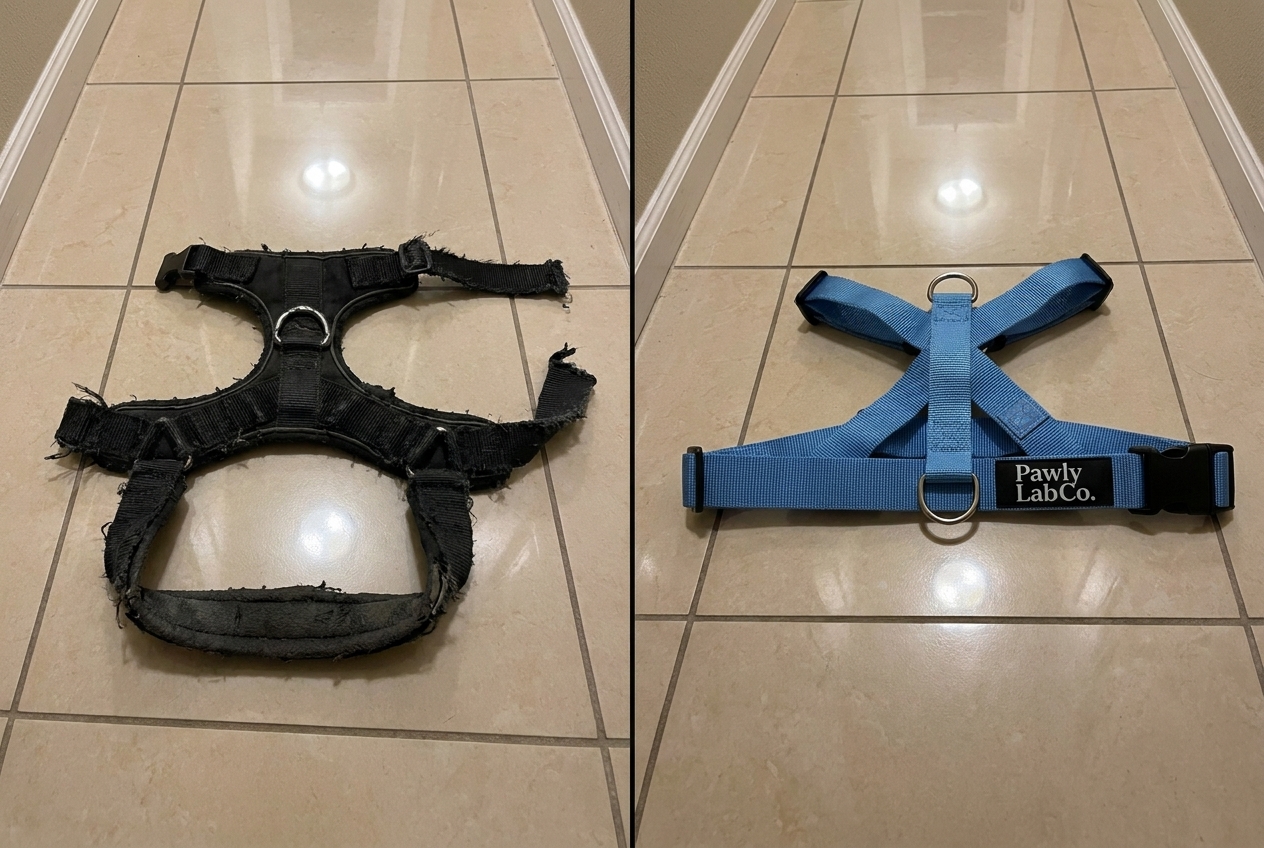
The most common harness sold in America was engineered for sled dogs — to maximize the power they push into the harness. Then it was padded, recolored, and sold to you as 'safe.'
The Problem Isn't the Walk. It's What's On the Dog.
Once I understood what was actually happening, I realized we've been fighting the wrong enemy. Not the walk. Not the breed. Not the age. The clip position.
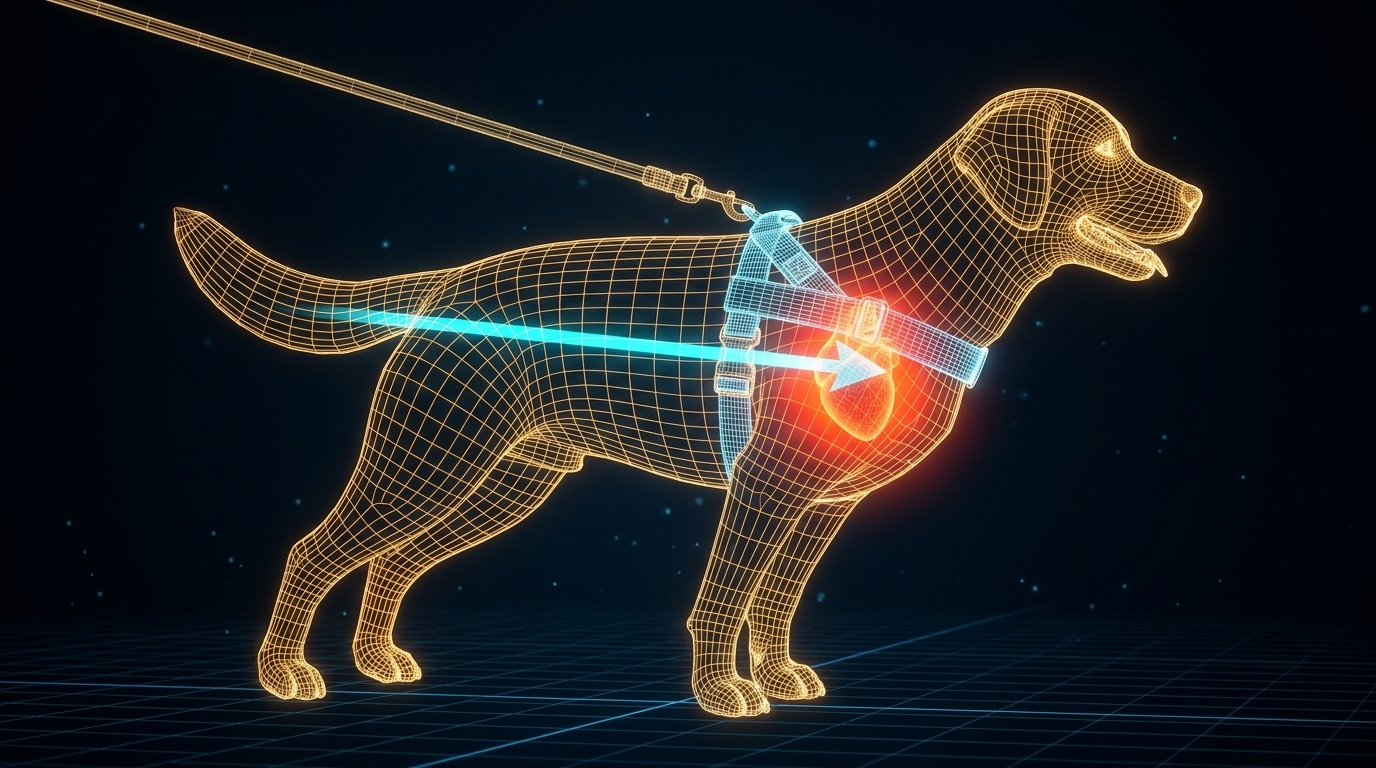
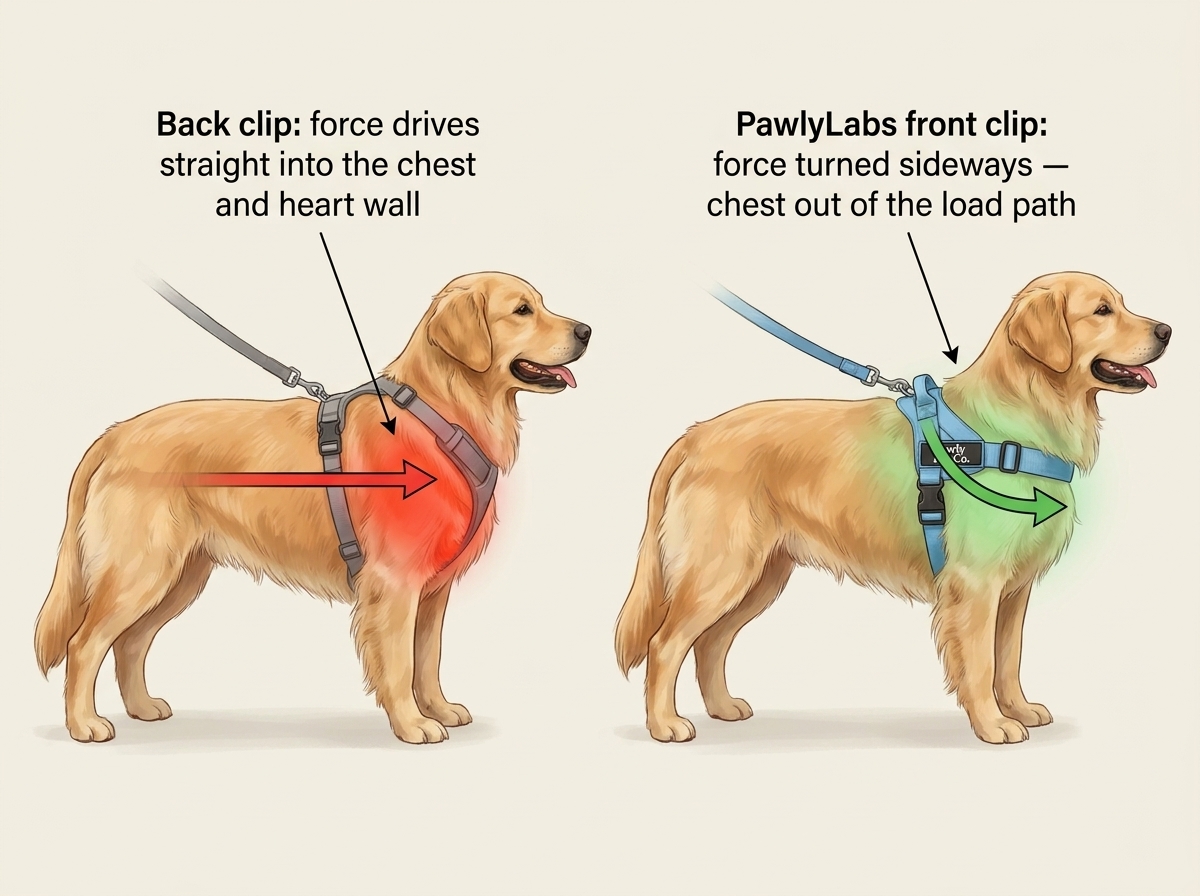
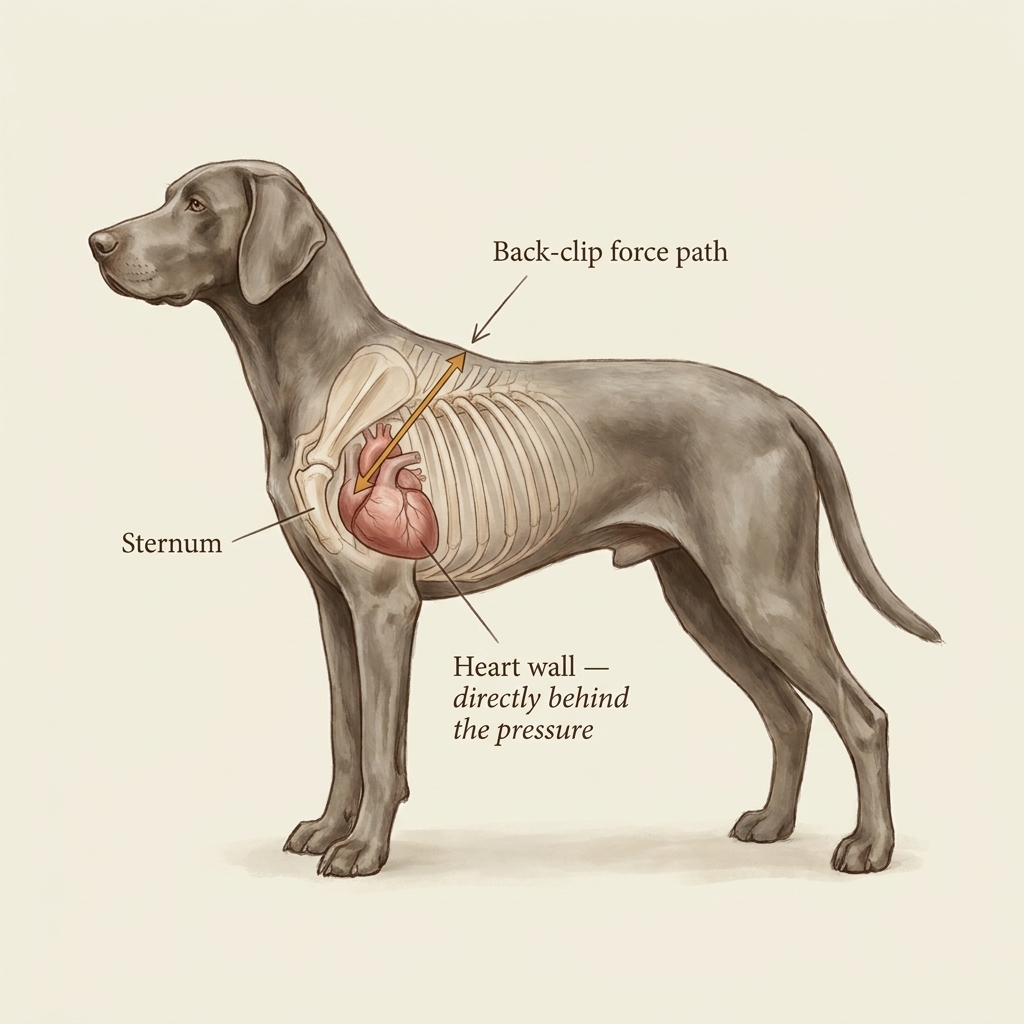
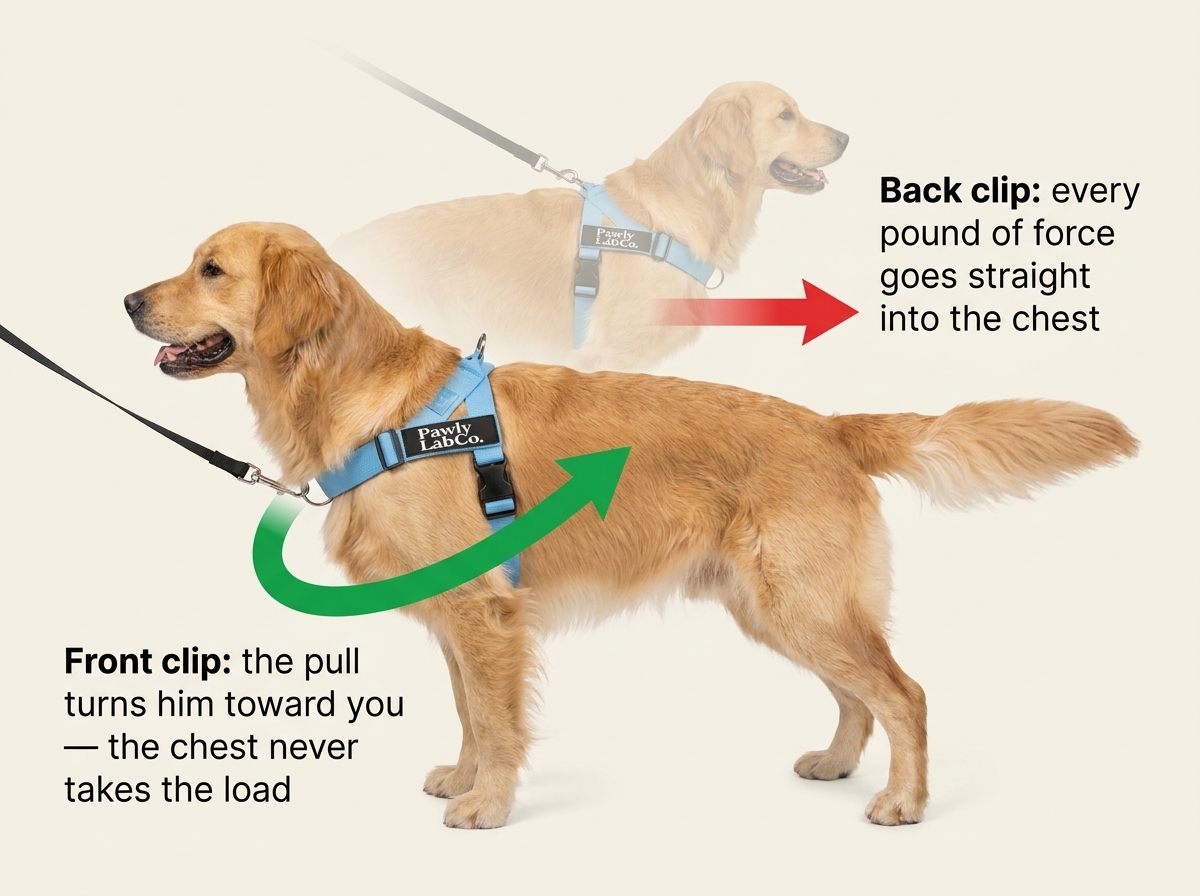
When the harness clips between the shoulder blades and your dog pulls forward, every single pound of force travels in a straight line — directly into his chest cavity.
Where does the force actually go?
That's not a design flaw. It was engineered that way — for sled dogs. On a sidewalk, with a pet, that same geometry means your dog's chest absorbs the full load of every pull. His sternum. His ribcage. His heart wall. Thousands of times per walk. For years.
Dogs don't show you this pain. Their survival instinct suppresses it.
Showing weakness in the wild gets an animal killed. So they push through, walk after walk, while the strain builds silently. And they ARE trying to tell you. That's why some dogs freeze before walks. Why others hide when the harness comes out. Why a dog who loves running will suddenly stop and sit mid-walk for no obvious reason. His body is telling him to stop. But he loves you too much to refuse. Chronic pressure on the chest doesn't stay in the chest. It works inward — deeper with every pull. The heart sits right behind it. By the time you notice — labored breathing, slowing down on walks — it has been building for months. Or years.
That's when it hit me: the only harness that could protect the chest was one that took the chest out of the load path entirely — by moving the clip to the sternum.
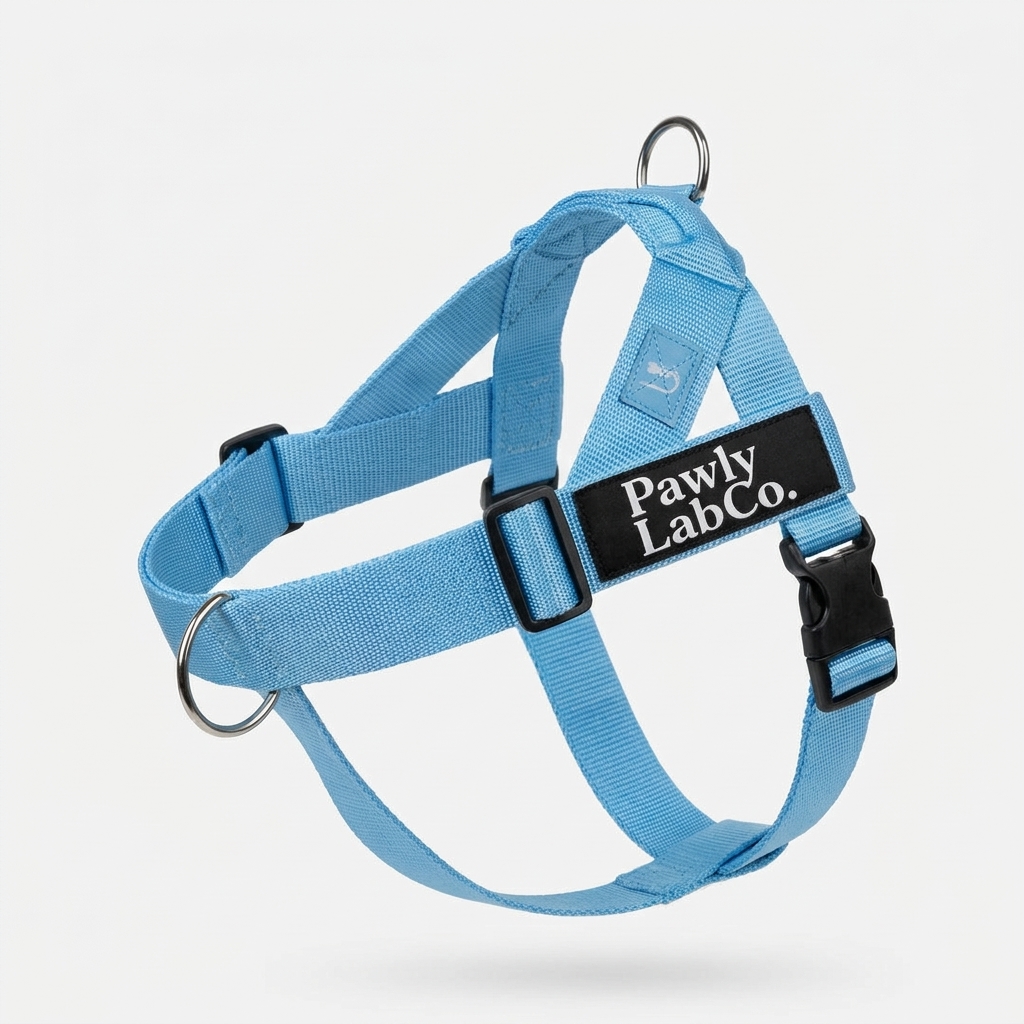
Introducing the PawlyLabs No-Pull Harness: The First Front-Clip Harness Designed Around Chest-Pressure Elimination
I tested every alternative I could find — and every one failed (more below). So I worked with a team of harness engineers and built one from the anatomy up.
A harness that redirects the force before it ever reaches the chest — so the pulling stops on the first walk, and the heart wall is never in the load path.
Here's what makes it different from every harness in the pet aisle:
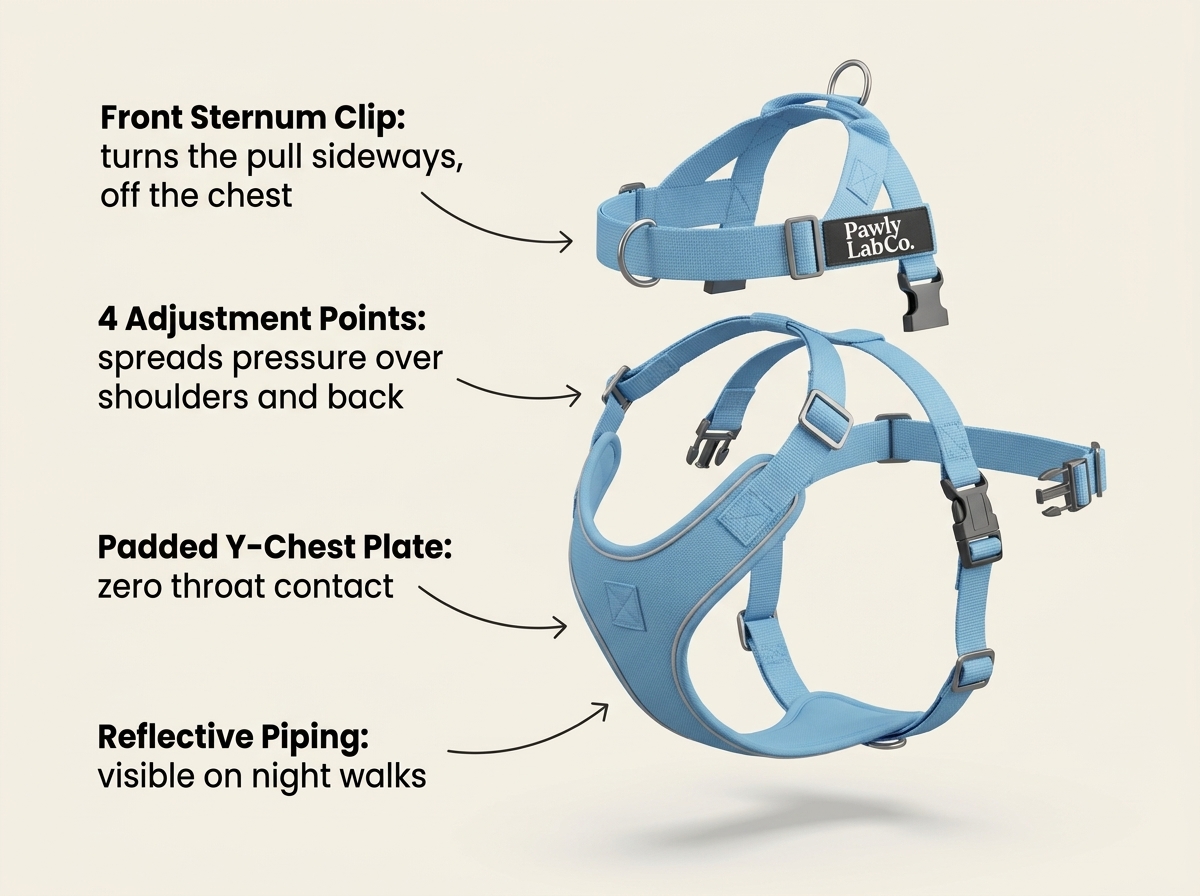
1. Front Sternum-Clip Redirect System
The clip sits at the sternum instead of the shoulder blades. When your dog pulls forward, the geometry rotates his body sideways — toward you — instead of driving force straight in. The chest never absorbs the load. And because pulling no longer moves him forward, it stops being worth doing.
Result: It's not training. It's not force. It's geometry — and geometry works on the first walk.
2. Four-Point Pressure-Distribution Fit
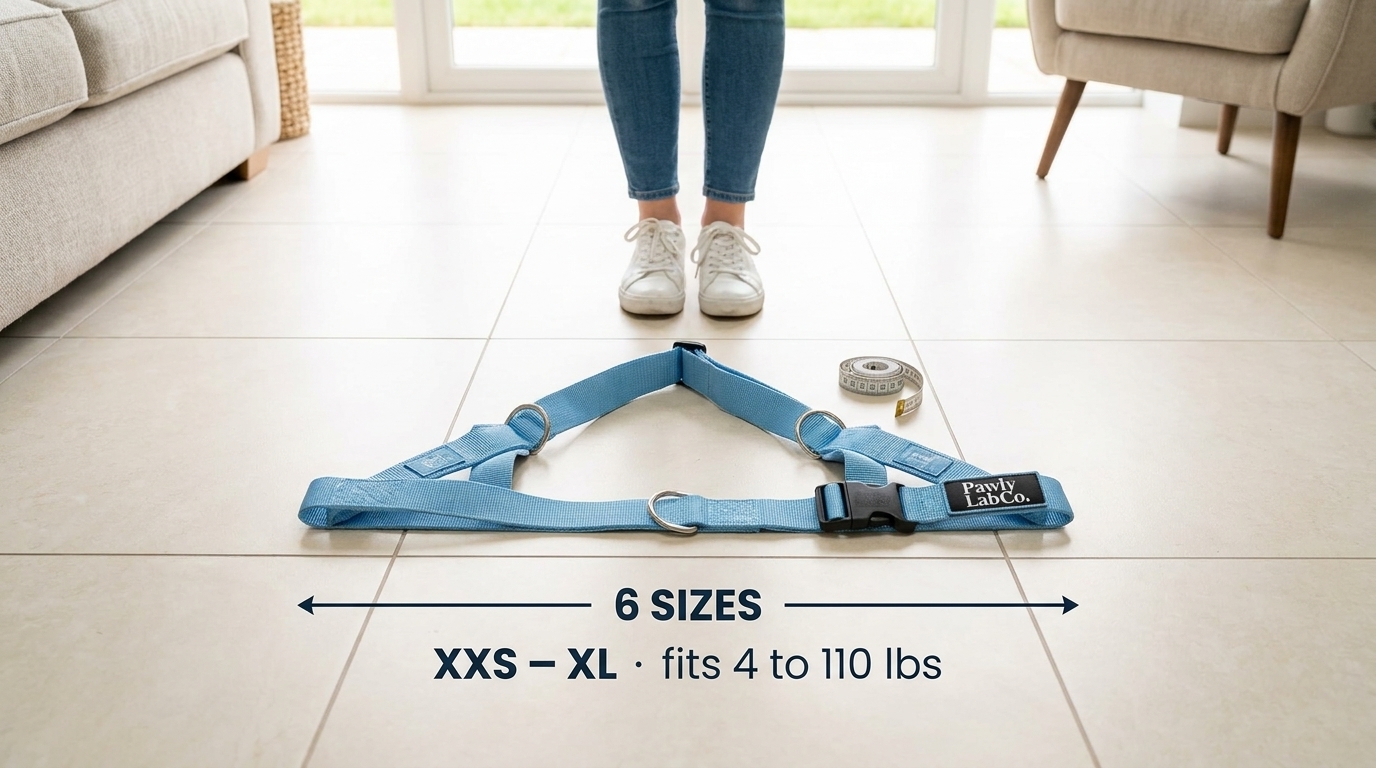
Any incidental pressure is spread across the shoulders and back — the structures actually built to handle load — never concentrated in one place. Four adjustment points set that fit to his body, from a 4-lb XXS to a 110-lb XL.
Result: No single point of force. No hidden hot spot building walk after walk.
3. Padded Y-Plate: Zero Throat Contact
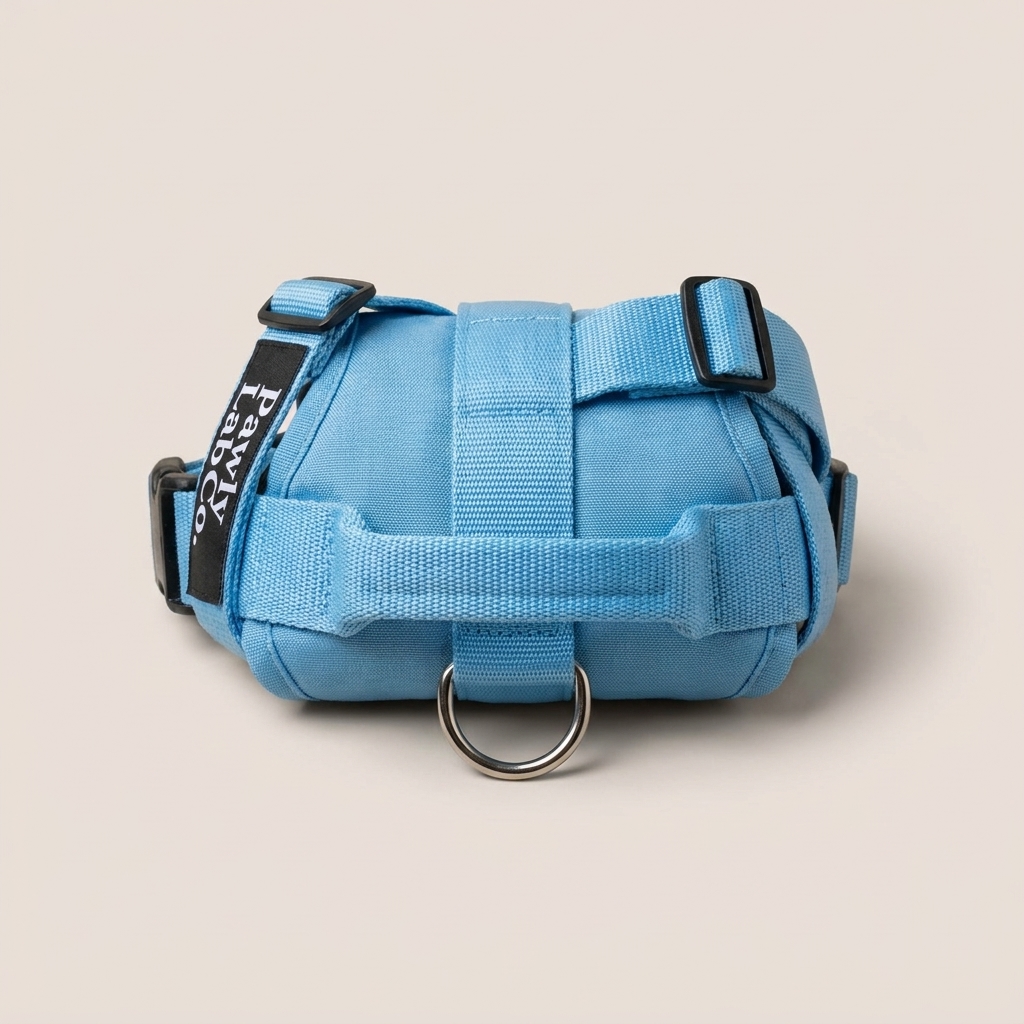
Prong collars and slip leads trade chest strain for throat strain. The padded Y-shaped chest plate keeps every strap off the trachea and spreads contact across the sternum — the one structure designed to carry it.
Result: Zero pressure on the trachea. No coughing, no gagging, no wheezing at the end of a walk.
4. Vet-Designed From the Anatomy Up
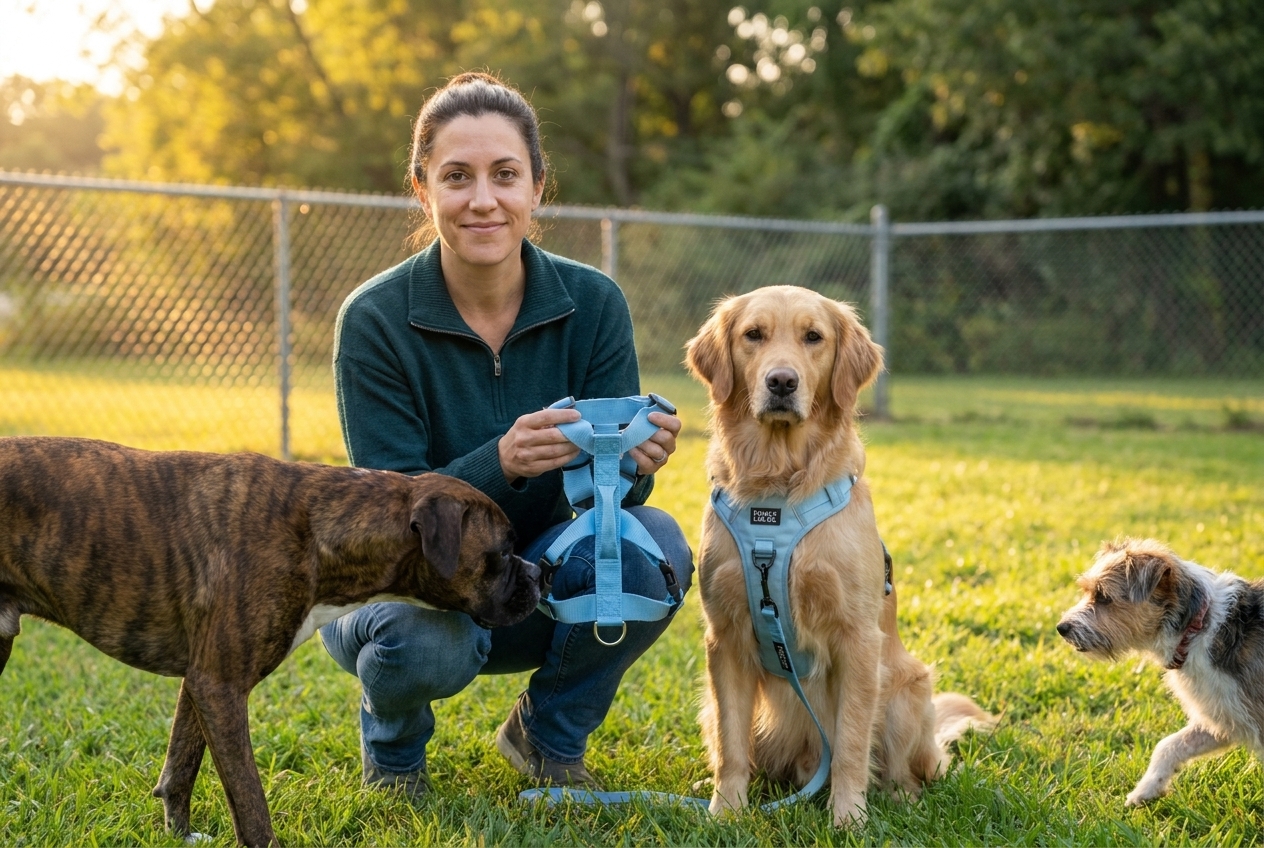
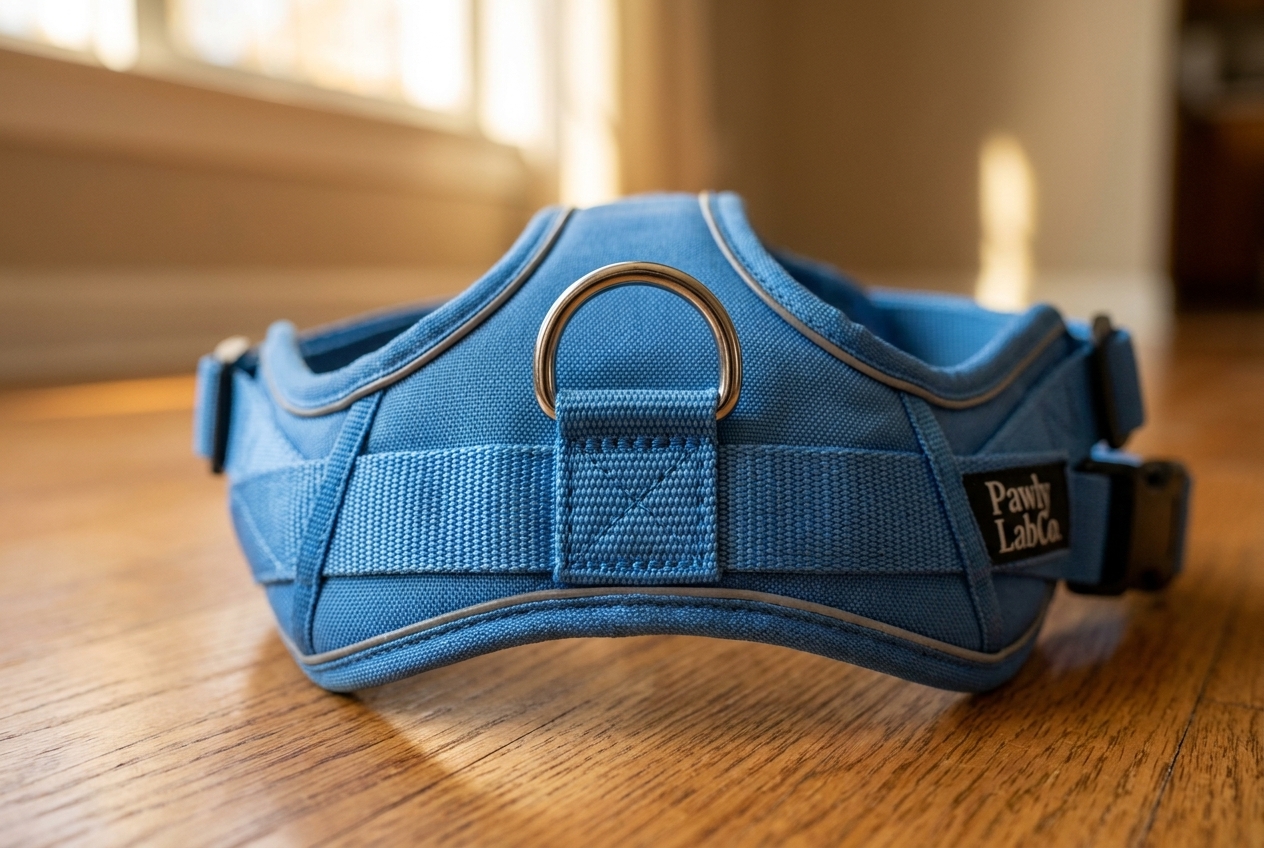
Not sled-dog equipment repurposed for a pet market. Every strap angle was drawn from canine anatomy first — then built with heavy-duty nylon webbing, reinforced box stitching and metal hardware, backed by a lifetime warranty.
Result: A harness whose geometry starts with your dog's body — not with a sled.
In my own clinic trial, here's what we saw:
Walk 1
Pulling dramatically reduced — on the very first walk
Week 2
Dogs approaching the harness without hesitation
21 of 23
Dogs walking longer, moving easier, and showing none of the stress signals — over 8 months
Where the Clip Sits Decides Where the Force Goes:
BACK
clip = force straight into the chest
⟶
FRONT
clip = force turned sideways, away from the heart
CHEST-SAFE DESIGN
That's when I knew I couldn't keep this inside my clinic.
A dog mom called me at 10:47 PM. Her eight-year-old golden retriever, who had been slowing down on walks for nearly a year, had just completed their full route for the first time in months. She was crying: 'He's moving like he used to, doctor.' Another family's vet wrote to me: 'I don't know what changed, but these are the strongest numbers I've seen from this dog in four years.' Today the harness has 10,423+ verified reviews.
Verified buyer
United States
★★★★★
My dog pulled so hard I dropped my phone and cracked the screen. That was my breaking point. Got this harness and the pulling stopped that same day. Should've gotten it sooner. Saved my sanity.
✔️ Verified Purchase
Verified buyer
United States
★★★★★
I stopped inviting friends over because my dog would jump and pull when they arrived. Got this harness and he's so much calmer.
✔️ Verified Purchase
Verified buyer
United States
★★★★★
Tried everything. Prong collars, head halters, three different harnesses. Nothing worked until this. The front clip breaks the pulling habit instantly. My Husky walks beside me now.
✔️ Verified Purchase
Verified buyer
United States
★★★★★
I have arthritis and putting on harnesses was painful. This one slips over his head and snaps once. So easy. And he doesn't pull anymore so my hands don't hurt either.
✔️ Verified Purchase
Verified buyer
United States
★★★★★
My shoulder hurt so bad I considered rehoming my dog. Tried this harness as a last resort. Three weeks later, zero pain. The front clip stops the pulling without me fighting back. Life-changing.
✔️ Verified Purchase
Jenn & Nala
United States
★★★★★
Nala loves her harness! She wants to wear it all the time. Plus it has made outdoor time much more enjoyable. Thank you!
✔️ Verified Purchase
What dog parents tell us most:
✔️The pulling stopped on the very first walk
✔️Dogs who used to hide from the harness now wait by the door for it
✔️No more coughing or gagging at the end of a walk
✔️On and off in seconds — even with arthritis
⭐ 4.8 Rated by 10,423+ Dog Parents
🛡 30-Day At-Home Trial
✅ Lifetime Warranty
🚚 Free Shipping
🔒 Secure Checkout (SSL)
4.8★ 10,423+ REVIEWS
30-DAY AT-HOME TRIAL
LIFETIME WARRANTY
FREE SHIPPING
The PawlyLabs Harness vs. Regular Back-Clip Harnesses: The Real Comparison
Feature
PAWLYLABS
Regular Back-Clip
Clip Position
✔ Front sternum ring
⊗ Between the shoulder blades — sled rigging
Where the Force Goes
✔ Turned sideways, toward you
⊗ Straight line into the chest cavity
Chest & Heart Wall
✔ Out of the load path
⊗ Absorbs the full load of every pull
Throat
✔ Zero trachea pressure
⊗ Chokes when he lunges
Pulling on Walk One
✔ Stops being worth doing
⊗ Rewarded — he moves forward
Stress Signals
✔ Dogs approach the harness
⊗ Freezing, hiding, sitting mid-walk
Fit Range
✔ XXS–XL · 4–110 lbs, 4 points
⊗ One or two sliders
Night Visibility
✔ Reflective piping
⊗ Dark webbing
Warranty
✔ Lifetime
⊗ 90 days, if any
Cost Over Time
✔ One-time
⊗ Gadget after gadget — then the vet bill
Why the Alternatives Don't Work:
Standard back-clip harnesses — chest force on every pull. Same problem, every brand. Harnesses marketed as 'no-pull' with the clip still on the back — IDENTICAL physics, different packaging. Prong collars — trading chest strain for throat and spine strain. Head halters — dogs spend the entire walk pawing at their face, the skin under their eyes raw within weeks. Trading one problem for another. I was ready to give up.
Why the PawlyLabs Harness Works:
Because I'm not the kind of person who accepts that dogs have to suffer. So I got obsessed. Biomechanics studies. Veterinary rehabilitation literature. Force-vector analysis. And in the research on how clip position decides where force travels inside a dog's body, I found the ONE principle that removes the chest from the load path entirely: redirect the force before it reaches the chest. No harness on the market was built around it.
🔬
How Clip Position Decides Where the Force Goes
The physics behind why the chest stays out of the load path
I'm not asking you to 'just trust me.' Let me show you exactly how this works:
The Physics of a Back Clip
A leash clipped between the shoulder blades pulls along the dog's spine. When he drives forward, the force runs in a straight line through the harness into the front of the chest cavity — sternum, ribcage, heart wall. That is exactly the geometry sled harnesses were designed for. And the dog's own Opposition Reflex makes him lean INTO that pressure, harder, on every step.
What We Did Differently
We mapped where pulling force actually travels — and moved it:
✔The sternum clip rotates the body sideways, so forward force never drives into the chest
✔Four adjustment points spread any incidental pressure across the shoulders and back
✔The padded Y-plate keeps the throat at zero pressure at any leash angle
What This Means for Your Dog
The moment he pulls, his own momentum swings him toward you, the chest never takes the load, and the leash goes slack. The heart wall is never in the path. And because pulling no longer gets him anywhere, it stops being worth doing — on the first walk.
"It's not training. It's not force. It's geometry. And geometry works on the first walk."
✔
Vet-Designed, Chest-Safe Geometry
Get the Same Harness I Use in My Clinic
Choose the setup that fits your walks
Why Most Dog Parents Choose the Complete Walk Kit:
Based on my clinic trial and 10,000+ dog parents, here's what we recommend:
✔Harness sized to his chest — XXS to XL fitting guide included
✔Classic 5-ft leash — included free
✔Bungee leash upgrade — absorbs sudden squirrel-lunges before they reach his chest or your shoulder
✔Custom name patch — so he's never 'that dog', he's Cooper
✔ID tag with your number — for the just-in-case days
✔AirTag holder — see where he is, always
With free shipping and the 30-day at-home trial, you're covered for every walk — and every what-if.
My 'Cooper Promise' to You
I built this harness because I never want to give another sobbing dog mom the textbook answer at 4:23 AM. So here's my promise:
Try the Harness Risk-Free for 30 Days
Walk him every single day.
If the pulling doesn't reduce — or if you're not completely satisfied for ANY reason — send it back within 30 days and we'll refund every penny. And if a buckle, strap or stitch ever fails, the lifetime warranty replaces it. No restocking fees. No interrogation.
Why I'm So Confident:
Because I tested the first version in my own clinic — 23 dogs, eight months, every one of them improved. Because 10,000+ dog parents have already made the switch. Because once you see him walk easier, you will never put the old harness back on.
Every single walk you wait, that force is loading your dog's chest. It doesn't announce when it's had enough.
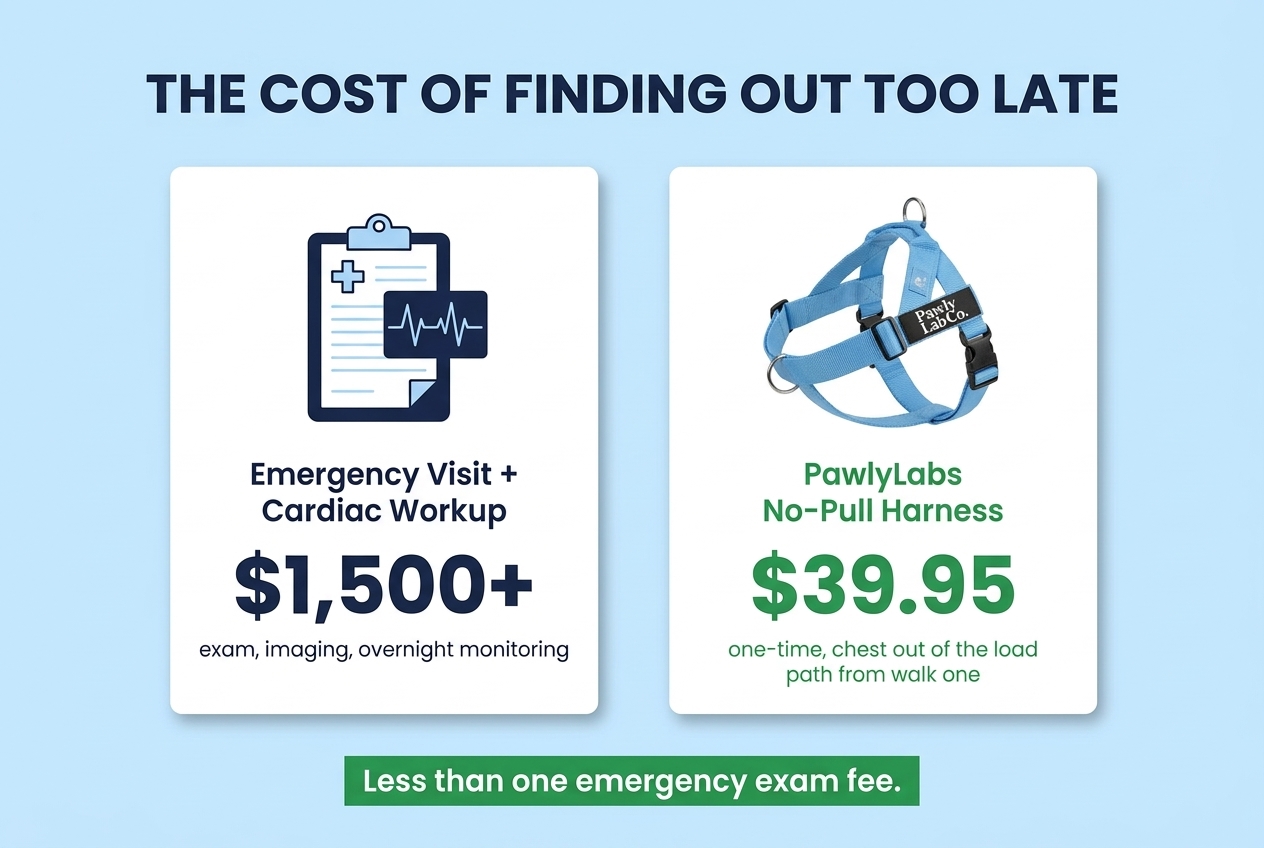
If this harness spares you even ONE 4 AM drive to an emergency room, it's paid for itself many times over. If it gives you back the long, easy walks you pictured when you brought him home — it's priceless.
Return within 30 days of delivery for a full refund. See the size guide before ordering.
Fair Warning: Popular Sizes Sell Out
Right now the harness is 60% off with a free leash. I can't promise how long that holds — what I can tell you is that we produce in batches, and the mid sizes go first. M and L routinely sell out ahead of a restock.
XXS–XS:
Usually available
M–L:
First sizes to sell out
XL:
Smaller batches
I'm telling you this as a clinician, not a countdown timer. If his size is in stock today, that's the batch your harness ships from.
If you're ready to take his chest out of the equation, I recommend ordering today.
Common Questions
My dog seems perfectly fine on walks. Do I really need to worry?
That's lie number one. Of the 94 daily-walked 'healthy' dogs I documented, 79 were already showing signs of strain. Dogs hide pain by instinct. 'Seems fine' is not the same as fine.
What are the signs my dog is trying to tell me?
Freezing before walks. Hiding when the harness comes out. Sitting down mid-walk for no obvious reason. Later: reluctance to exercise, labored breathing, slowing down. If you've seen any of these, don't wait.
Will it really reduce pulling without training?
Yes. When the clip sits at the sternum, pulling turns him sideways instead of moving him forward — so pulling stops being worth doing. Training still helps long-term manners; it just isn't required.
I already own a 'no-pull' harness. Isn't that the same thing?
Check where the clip is. If it's on the back, the physics are identical — the force still drives straight into the chest. The marketing changed; the anatomy didn't.
Will it choke or chafe him?
No. The padded Y-plate keeps every strap off his throat and armpits, and any contact spreads across the sternum — the one structure designed to carry it.
Does it work for puppies?
From about 4 lbs (size XXS) and up. The earlier he learns that a slack leash feels normal, the less force his chest ever absorbs.
What about big, powerful breeds?
Big pullers have the most force going into the chest — and the front clip helps them most. Sizes run to a 110-lb XL with four adjustment points.
How do I get his size right?
Measure his chest at the widest point and match it to the chart (XXS–XL). Picked wrong? Exchanges are free inside the 30-day trial.
How long does shipping take?
Shipping is free, and US orders typically arrive within 2–7 business days.
What's your return policy?
A 30-day at-home trial: full refund, no restocking fees, no questions asked — plus a lifetime warranty on the harness itself.
Give Your Dog Walks That Don't Cost Him His Heart
A Personal Message from Dr. Monroe:
Cooper's still alive today. Nine years old now. His heart never fully recovered — the damage was already done. But it stopped getting worse. He's happy. Slower than he used to be. But still walking.
His mom tells me at every checkup: 'I just wish I'd known sooner.'
That statement haunts me. Because I do know. And now so do you. Maybe your dog has started hesitating at the door. Maybe he sits down halfway through the route you've walked for years, and you've told yourself he's just getting older. Let me tell you what 11 years of overnight shifts taught me:
Your dog isn't fine because he looks fine. He looks fine because he loves you too much to tell you otherwise — and the gear you were sold is loading his chest on every step.
This harness takes his chest out of the equation entirely. I've watched it work in my clinic — anxious rescues, powerful adolescents, senior goldens who hadn't finished a full route in a year.
It works because it starts with his anatomy — not with a sled.
You've tried the harness that 'tightens when he pulls.' The prong. The head halter he clawed at until his face was raw.
Give this one thing a try. I promise you won't regret it.
If it doesn't work, we'll refund every penny. But I don't think that's what will happen. I think the leash is going to go slack on your first walk. I think by week two he'll be waiting by the door for it.
Give your dog walks that don't cost him his heart — before more damage gets done.